







It was inconceivable, five years ago, that a conservative country like Colombia would eliminate the crime of abortion from the penal code (up to the 24th week of pregnancy). Or that Catholic and neoliberal Chile would vote for a constitution that enshrines sexual and reproductive rights, including voluntary abortion.
In February of this year, Colombia’s constitutional court eliminated the crime of abortion (up to 24 weeks of gestation) from the criminal code, in response to a lawsuit filed by Causa Justa, spearheading a broad social and legal campaign involving more than 120 movements and thousands of activists.
Colombia thus put itself “at the forefront of the region and the world,” according to physician and feminist activist Ana Cristina González, one of the spokespersons for Causa Justa.
The campaign, which was launched in February 2020, “was the result of a national and international political accumulation,” which changed “the public debate on abortion in Colombia,” and became a “collective and articulated movement,” Gonzalez said at a meeting in Montevideo.
Abortion was totally prohibited in Colombia until 2006, when a constitutional court ruling, promoted by several Causa Justa activists, decriminalized it on three grounds: danger to the health or life of the woman, incompatibility of the fetus with extrauterine life, and rape.
The same avant-garde air of Colombia was breathed in Uruguay in 2012, when the country legalized abortion up to 12 weeks. And again it was felt in Argentina in 2020, when Congress adopted a law allowing abortions up to 14 weeks, after a decades-long struggle. The “green tide,” after the color of the bandanas of the campaign for legal, safe and free abortion, inspired and energized the entire region.
Progress in Chile and Mexico
But the frontiers of what is possible continue to stretch in Latin America.
Barely a month after the Colombian ruling, Chile’s constitutional convention – which is drafting a new constitution – approved (by a large majority) an article that enshrines sexual and reproductive rights as fundamental and guaranteed by the state. These rights include abortion.
The article establishes that “all persons are entitled to sexual and reproductive rights [which include, among others] the right to decide freely, autonomously and in an informed manner about one’s own body, about the exercise of sexuality, reproduction, pleasure and contraception”.
Furthermore, it adds, the State shall guarantee the exercise of these rights “without discrimination, with a focus on gender, inclusion and cultural relevance”, and “ensuring to all women and persons with gestational capacity, the conditions for a pregnancy, a voluntary interruption of pregnancy, voluntary and protected childbirth and maternity”.
Abortion was totally banned in Chile by the dictatorship of Augusto Pinochet (1973-1999), and only since 2017 has been allowed in cases of rape, fetal non-viability and risk of life for the woman.
If the new constitution is approved by popular vote in September, Chile could become the first country in the world to give constitutional status to abortion rights.
Last year, Mexico’s supreme court declared unconstitutional the absolute criminalization of abortion and invalidated a federal law that allowed health personnel to refuse to perform abortions on the grounds of “conscientious objection”.
Advocacy Between 2005 and 2012, the treatment rate for complications from unsafe abortions decreased by one-third.
This ruling means that no woman can go to jail for having an abortion, establishes case law and puts pressure on states to legalize abortion.
In fact, seven Mexican states have already legalized voluntary abortion in the first 12 weeks of gestation, five of them in the last year and a half: Mexico City (2007), Oaxaca (2019), Veracruz, Hidalgo, Baja California, Colima (2021) and Sinaloa (2022).
Today we can say that 37% of the population of Latin America and the Caribbean, amounting to 652 million people, live in countries where women have won the right to legal abortion or not to be imprisoned for having an abortion (also including Cuba, Guyana and Puerto Rico). Five years ago the proportion was less than 3%.
None of this would have been possible without activism, feminist networks, mobilizations, the discussion on women’s autonomy.
Moreover, thanks to advances in medicine and feminist innovation, abortion mortality has continued to fall.
Between 2005 and 2012, the rate of treatment for complications from unsafe abortions decreased by one-third, according to the Gutmmacher Institute, which acknowledges that the use of the drug misoprostol “became more common throughout the region” and “appears to have increased the safety of clandestine procedures.”
Feminist innovation? It was Latin American feminists who detected, in the 1990s, that misoprostol was effective and safe for terminating pregnancies. Today, it is a drug recommended by the World Health Organization and adopted by the health systems of many countries.
They were also the ones who established a day of struggle – the Global Day of Action for Access to Safe and Legal Abortion – which today is observed around the world every September 28th.
Much remains to be done
But even with this remarkable progress, millions of people still live with a reality. Abortion is completely banned in El Salvador, Haiti, Honduras, Nicaragua, the Dominican Republic and Suriname. In El Salvador, women can face sentences of up to 50 years for miscarriage or stillbirth.
In Belize, Bolivia, Brazil, Costa Rica, Ecuador, Guatemala, Panama, Paraguay, Peru and Venezuela, abortion is permitted only in very limited circumstances – usually when the woman’s health or life is at risk. Belize also considers economic and family hardship and, along with Brazil and Panama, rape and severe fetal defects.
Girls and raped women are forced to give birth not only in countries with absolute prohibition, but also in Costa Rica, Guatemala, Paraguay, Peru and Venezuela. In Ecuador, where the parliament approved abortion in cases of rape, President Guillermo Lasso partially vetoed the law.
There is little hope for a relaxation of abortion restrictions in Central America, but the next big change could come in the most populous country, Brazil, with 212 million inhabitants.
There, termination of pregnancy is only allowed in cases of rape, health risk to the woman or anencephaly of the fetus, and the practice is hindered by Jair Bolsonaro’s own ultra-right-wing government, which mobilizes groups of fanatics to harass women and health personnel.
Brazil will hold elections in October, and the current favorite, former president Luiz Inácio Lula da Silva, recently said he agrees with legalizing it, although in recent weeks he has approached Christian collectives, which are fiercely opposed.
Bolivia, no step forward
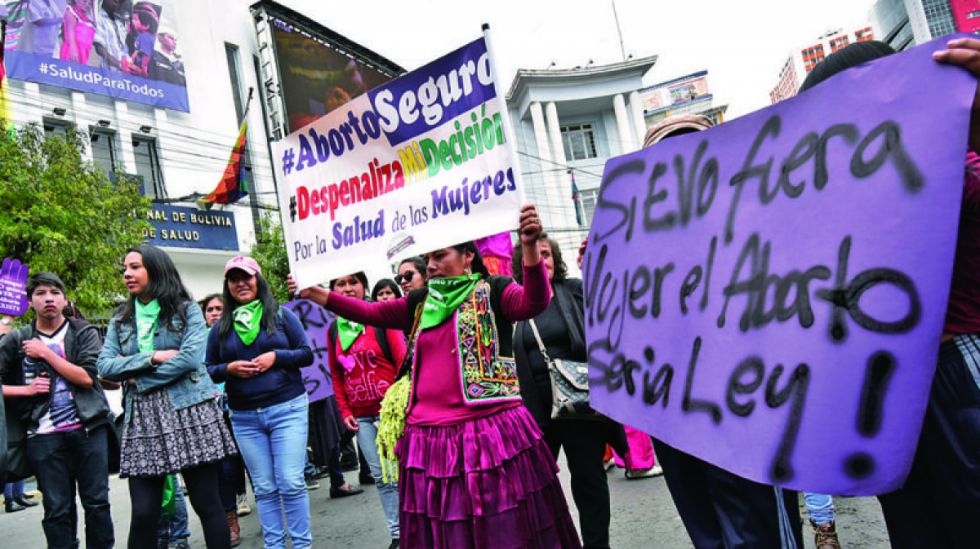
At the end of 2018, the executive sent to the Plurinational Assembly a bill to update the Penal Code. Its articles included a slight modification to the current one, approved during the dictatorship of Hugo Banzer and which already incorporated the risk to the mother, to the fetus and rape, although it could only be interrupted up to eight weeks. The modification of the government of Evo Morales did not extend the time but it did include a certainly subjective condition, such as poverty, in addition to the pre-existence of other children. The declared objective was to give women more opportunities to be able to plan their family situation, however, furious marches ended up repealing the bill and Bolivia was left without renewing the Penal Code.
The issue has not been discussed again, neither in the legislative nor in the executive framework, not even with the latest controversy raised by the pregnancy of a 12-year-old girl who had been raped and was finally legally terminated despite the efforts of certain sectors to prevent it.
U.S. Supreme Court draft envisions abortion repeal
The U.S. Supreme Court could be on the verge of ending the constitutional right to abortion nationwide, according to a draft majority opinion by the nine justices.
Politico published on Monday the text of Judge Samuel Alito’s ruling defining as “flagrant error” a historic decision issued by the Supreme Court in 1973 called Roe v. Wade.
The highest court confirmed Tuesday that the leaked document is authentic, but clarified that it does not represent a decision of the Court or the final position of any of its members on the issues in the case.
Such a leak is unprecedented in the modern history of the highest U.S. court and is generating an enormous stir in the country.
The court’s chief justice, Justice John Roberts, called the leak an “egregious breach of trust” and ordered an investigation.
U.S. President Joe Biden issued a statement Tuesday in reaction to the leak, before the court confirmed the authenticity of the document, in which he said:
“I believe a woman’s right to choose is fundamental. Roe has been national law for nearly 50 years, and basic fairness and the stability of our country’s law demand that it not be overturned. We will be ready when any ruling is issued,” he stressed.
“If the Court overturns Roe v. Wade, it will fall to our elected officials at all levels of government to protect a woman’s right to choose. And it will fall to the voters to elect politicians favorable to that right.”
What the draft says
The judges are expected to issue their ruling on this case in early July. According to Politico, this is a first draft and it is not uncommon for judges to change their minds during these drafting processes.
“Roe (v. Wade) was egregious error from the outset,” reads Justice Alito’s brief. “We hold that it should be overturned,” it adds.
“The time has come to abide by the Constitution and return the issue of abortion to the elected representatives of the people,” he adds.
If that is ultimately the opinion of a court with a majority of conservative justices, it would spell the end of abortion as a constitutional right, so states could either ban it altogether or restrict it.
The leaking of a Supreme Court decision on such a controversial and still contentious issue is unprecedented in recent U.S. history.
Abortion has been legal in the U.S. since the 1973 Supreme Court ruling that the state has no right to intervene in a woman’s decision about her pregnancy.
Over the past decade, numerous conservative-led states have passed rules that blatantly violate those parameters, with the stated goal of getting the Supreme Court to review and overturn the nearly half-century-old precedent.